
Quality checks after maintenance
These final checks are part of the maintenance work. They are distinct from the paid visual and extended technical inspections available before work is carried out. Explore inspections · What does a maintenance service involve?
After a maintenance service, a watch is not simply assembled and returned. The movement is checked for operation, stability and ease of use. Below, you can read which checks are carried out, why they matter and when a result is considered satisfactory or in need of attention.
Not every watch is the same. Age, construction, wear, movement type and parts availability determine what is realistically achievable. I therefore always assess a watch according to its technical condition, age and intended use.
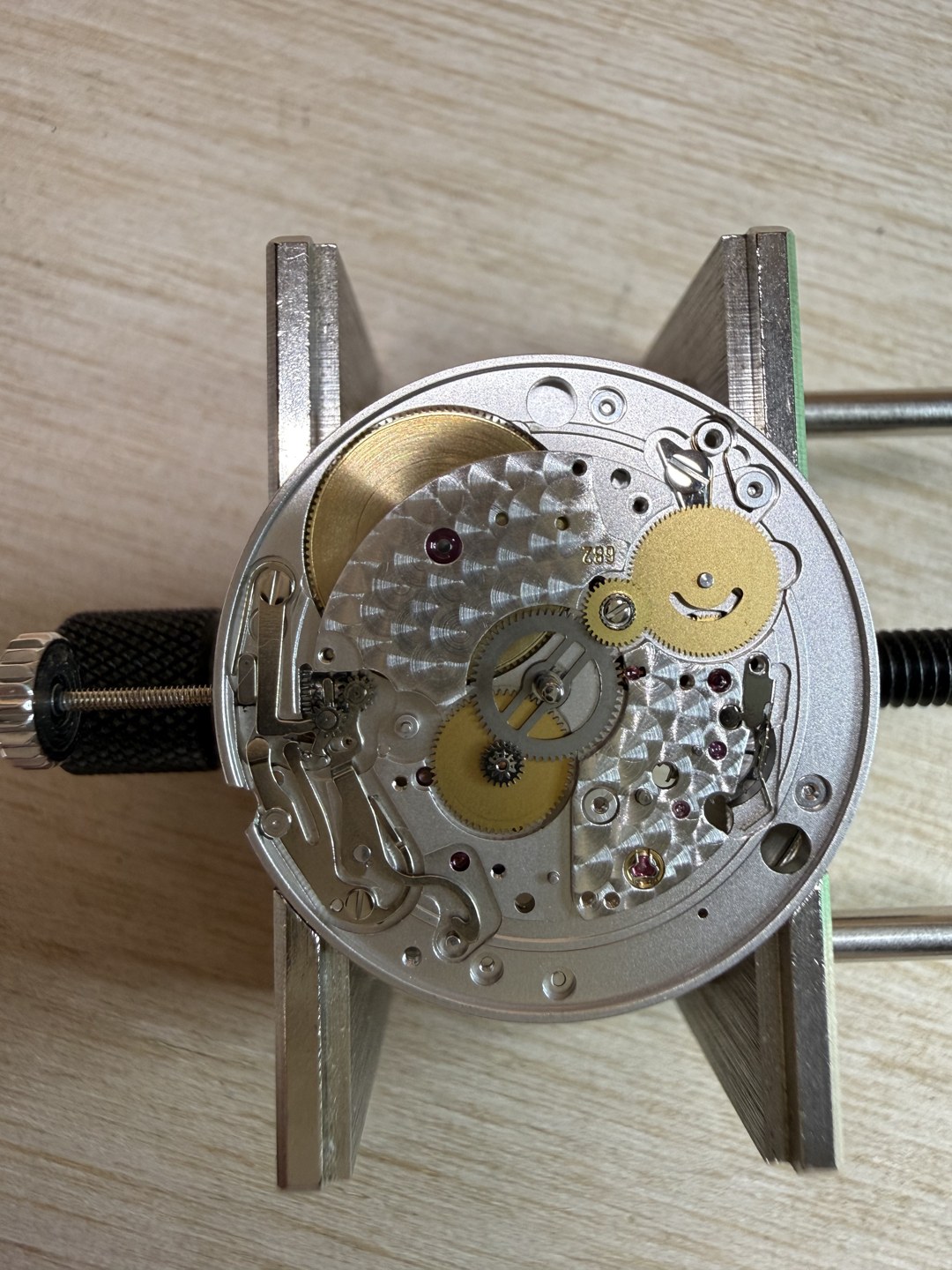
My own work: a mechanical movement during servicing.
Timekeeping and stability
Amplitude and accuracy in six positions
What do I test?
The watch is measured in six positions: dial up, dial down, crown up, crown down, crown left and crown right.
A timing instrument (“timegrapher”) measures amplitude, rate variation and beat error, among other things. Testing several positions provides a better picture of how the movement behaves during daily wear.
Why?
A mechanical watch does not keep exactly the same rate in every position. Factors include gravity, differences in friction between pivots and bearings, wear and the distribution of energy within the movement.
A well-running movement shows limited differences between positions. Large differences may indicate wear, contamination, imbalance or regulation problems.
What do I look for?
Among other things, I assess:
- amplitude
- rate variation
- beat error
- stability of the timing signal
- differences between positions
I also assess whether the measured values are reasonable for the movement type, age and construction. A vintage movement is assessed differently from a modern chronometer.
Green tick
Stable values appropriate to the movement type and age, with normal differences between positions.
Red cross
Large deviations, unstable or excessively low amplitude, highly variable measurements or marked differences between positions that indicate wear, contamination or regulation problems.
24-hour amplitude test
What do I test?
I check how amplitude develops over approximately 24 hours after the watch has been fully wound.
The watch is first fully wound and measured again after 24 hours, once part of its stored energy has been used.
Why?
A movement may appear to function well immediately after maintenance or at full wind, while problems become visible only as mainspring tension decreases.
The amplitude test provides information about the movement’s efficiency, the condition of its lubrication and the quality of energy transfer.
What do I look for?
I assess whether amplitude decreases gradually and reasonably as mainspring tension falls.
A gradual decline is normal. A sudden drop or unstable behaviour may indicate excessive resistance, contamination, worn bearings or problems in the gear train.
Green tick
Normal, stable decline in amplitude over time.
Red cross
A sharp or sudden drop, unstable behaviour or values that are not reasonable for the movement.
Power-reserve test
What do I test?
I check how long the watch continues running after it has been fully wound.
Why?
The power reserve provides information about the mainspring’s condition, the movement’s efficiency and total resistance within the mechanism.
A watch with excessive internal resistance will often stop sooner, because the energy remaining in the mainspring is insufficient to overcome that resistance.
What do I look for?
I compare the measured power reserve with what can realistically be expected for the particular calibre and age of the movement.
Small differences from factory specifications are not unusual in vintage movements.
Green tick
Power reserve is close to the value expected for the movement.
Red cross
Clearly insufficient power reserve.
Energy and extended testing
72-hour test
What do I test?
The watch is observed over several days while running, resting and simulating normal use. During the day it is on the watch winder, and at night it rests in the safe. This continues for three days and three nights.
Why?
Some problems appear only over time. Examples include date changes, reduced automatic winding or components that cause problems only at lower mainspring tension.
A brief measurement at the workbench does not always tell us enough about longer-term behaviour.
What do I look for?
I check whether the watch continues to run steadily, change functions correctly and remain free of irregular behaviour during extended observation.
Green tick
The watch continues to function reliably throughout the test period.
Red cross
Stopping, irregular running or malfunctioning functions.
Rotor winding checked on an automatic winder
What do I test?
For automatic watches, I check whether the automatic winding system actually stores energy.
Among other checks, the watch is tested on an automatic winder.
Why?
A watch may wind perfectly well by hand but still fail to build up enough energy during wear.
Problems in the automatic system are not always immediately visible. They can result from wear, contamination or an inefficient rotor design, for example.
What do I look for?
I assess whether the rotor turns freely, transfers enough energy and builds up the watch’s power reserve during simulated normal use.
For some movements, the direction of rotation also matters, as not every automatic system winds in both directions.
Green tick
The automatic system builds up energy reliably.
Red cross
Insufficient winding, unusual noises, slipping or jamming.
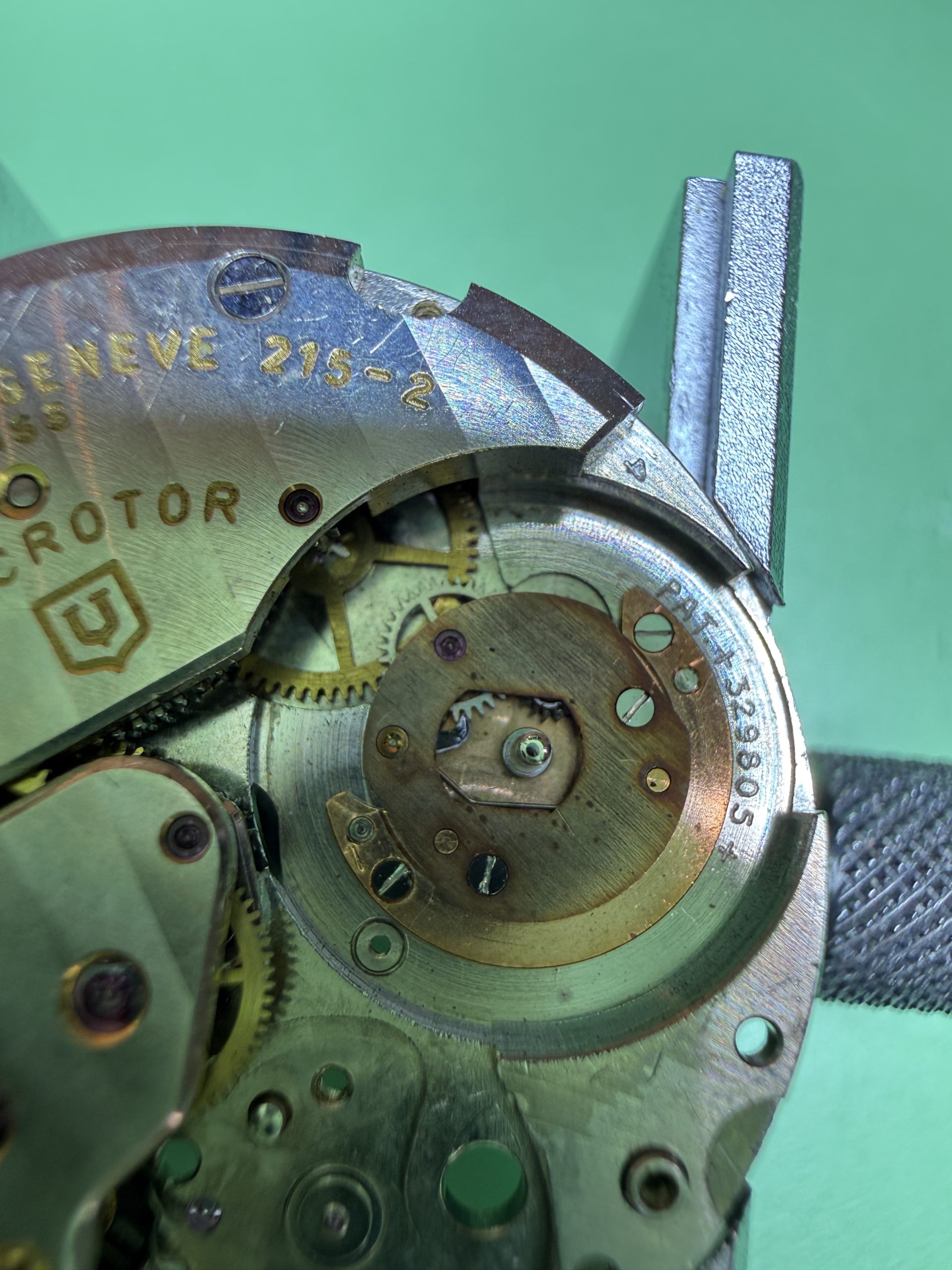
My own work: the micro-rotor forms part of the automatic winding system.
Operation and calendar
Hand-setting resistance checked
What do I test?
I check the setting of the hands using the crown.
Why?
Operation should feel smooth, controlled and predictable. Excessive resistance may indicate wear or incorrect assembly, while too little resistance may indicate play or worn components.
What do I look for?
I assess resistance, consistency and feel when setting the time.
I also check that the hands respond steadily, without jerks or unwanted movement.
Green tick
Consistent resistance and normal operation.
Red cross
Stiff operation, slipping, catching or irregular resistance.
Minute- and hour-hand alignment
What do I test?
I check whether the hour hand is correctly positioned when the minute hand points exactly to twelve.
Why?
Incorrect alignment usually occurs during hand fitting and may become visible at full hours or around date changes.
Although this need not be a direct technical fault, it affects the watch’s readability and finish.
What do I look for?
I check alignment at several full hours, assessing whether the hands are visually synchronised, fitted parallel and clear of each other and the dial.
Green tick
The hour and minute hands are correctly and neatly aligned.
Red cross
A clear mismatch between the hour- and minute-hand positions.
Date change between 23:55 and 00:05
What do I test?
I check whether the date changes correctly around midnight.
Why?
A correctly adjusted date mechanism should change the date around 00:00. An excessively early or late change may indicate incorrect assembly or wear.
What do I look for?
I check the start of the change, the switching moment and whether the date advances completely and cleanly.
Green tick
The date changes correctly around midnight, between 23:55 and 00:05.
Red cross
An excessively early or late change, incomplete change, skipping or jamming.
Date mechanism and quickset
What do I test?
I check both the normal date change and the quickset function.
Why?
The date mechanism contains relatively delicate components and small springs. Wear or incorrect operation may cause damage.
On many movements, for example, the quickset must not be used during the active date-change period (between nine and three o’clock).
What do I look for?
I check whether the date changes smoothly, indexes correctly and does not remain between two positions.
Green tick
The date changes reliably and the quickset works correctly.
Red cross
Skipping, jamming, stiff switching or incorrect indexing.
Complications tested
What do I test?
Additional functions such as a chronograph, GMT, moon phase, alarm or day/date are checked separately.
Why?
Complications add mechanisms to the movement, introducing additional wear points, tolerances and adjustments.
A movement may run well while a complication still fails to work correctly.
What do I look for?
I check operation, switching points, reset functions and the correct functioning of the relevant complication.
For chronographs, for example, I also assess reset alignment and smooth switching of start, stop and reset.
Green tick
Functions work as intended.
Red cross
Hesitation, incorrect reset, incomplete switching or unusual behaviour.
Finish and pressure testing
Visual check
What do I test?
I check the case, crystal, dial and hands for visible damage or contamination.
Why?
After maintenance, a watch should be clean and carefully assembled. Small dust particles or fingerprints often become visible only after assembly, under particular lighting or ultraviolet light.
What do I look for?
Under magnification, I check for dust, contamination, damage, loose components and the general finish.
Vintage watches are assessed with respect for their age and original condition.
Green tick
A tidy visual condition appropriate to the watch’s age and the condition in which it was received.
Red cross
Visible contamination, dust beneath the crystal, damage or assembly errors.
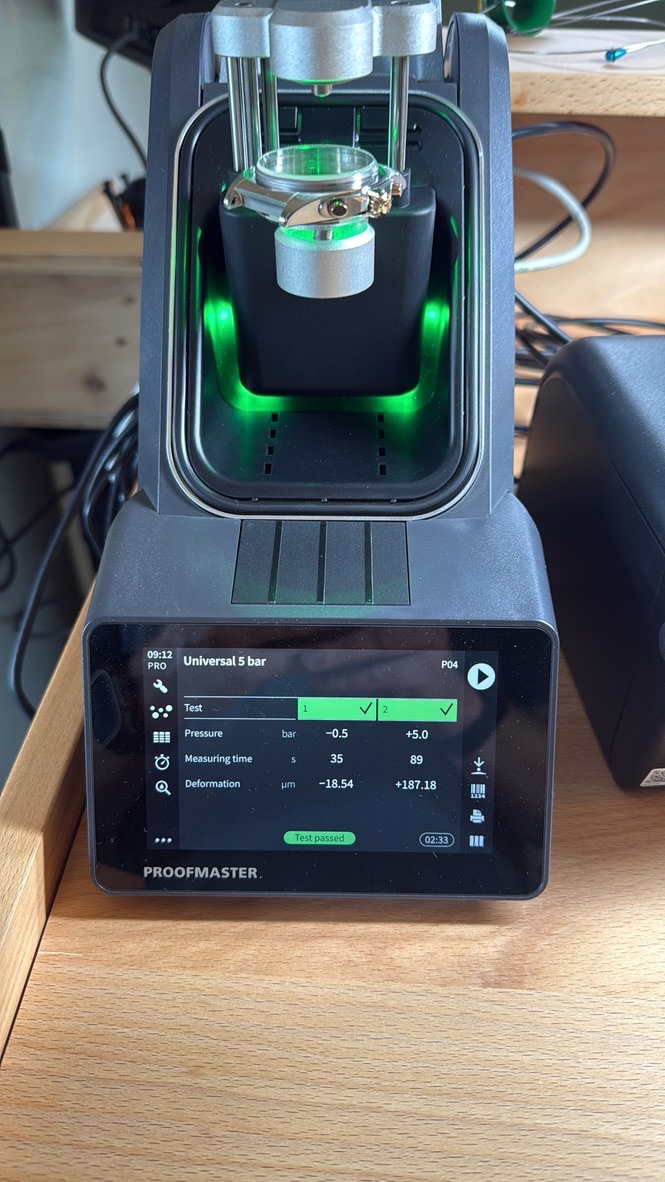
Pressure test performed: ___ bar
What do I test?
I test the case’s resistance to a pressure difference.
Depending on the watch, this uses negative pressure, positive pressure or a combination of both.
Why?
The test indicates whether the case, crystal, crown, pushers and gaskets provide an adequate seal at that time.
This can help assess whether the watch is suitable for normal use within the measured classification.
What do I look for?
I assess whether the case remains stable under pressure and whether there are signs of leakage or deformation.
Higher test values may be possible for modern watches than for vintage watches, where preserving original components can matter more than maximum water resistance.
Important qualification
Water resistance describes the condition at the time of testing. Temperature changes, ageing gaskets, impacts, chemicals and operation of the crown or pushers may affect it later.
Water resistance therefore does not mean that a watch is permanently “waterproof” in every situation.
Green tick
The watch passes the test at the measured value.
Red cross
An indication of leakage or an insufficient result for the intended use.
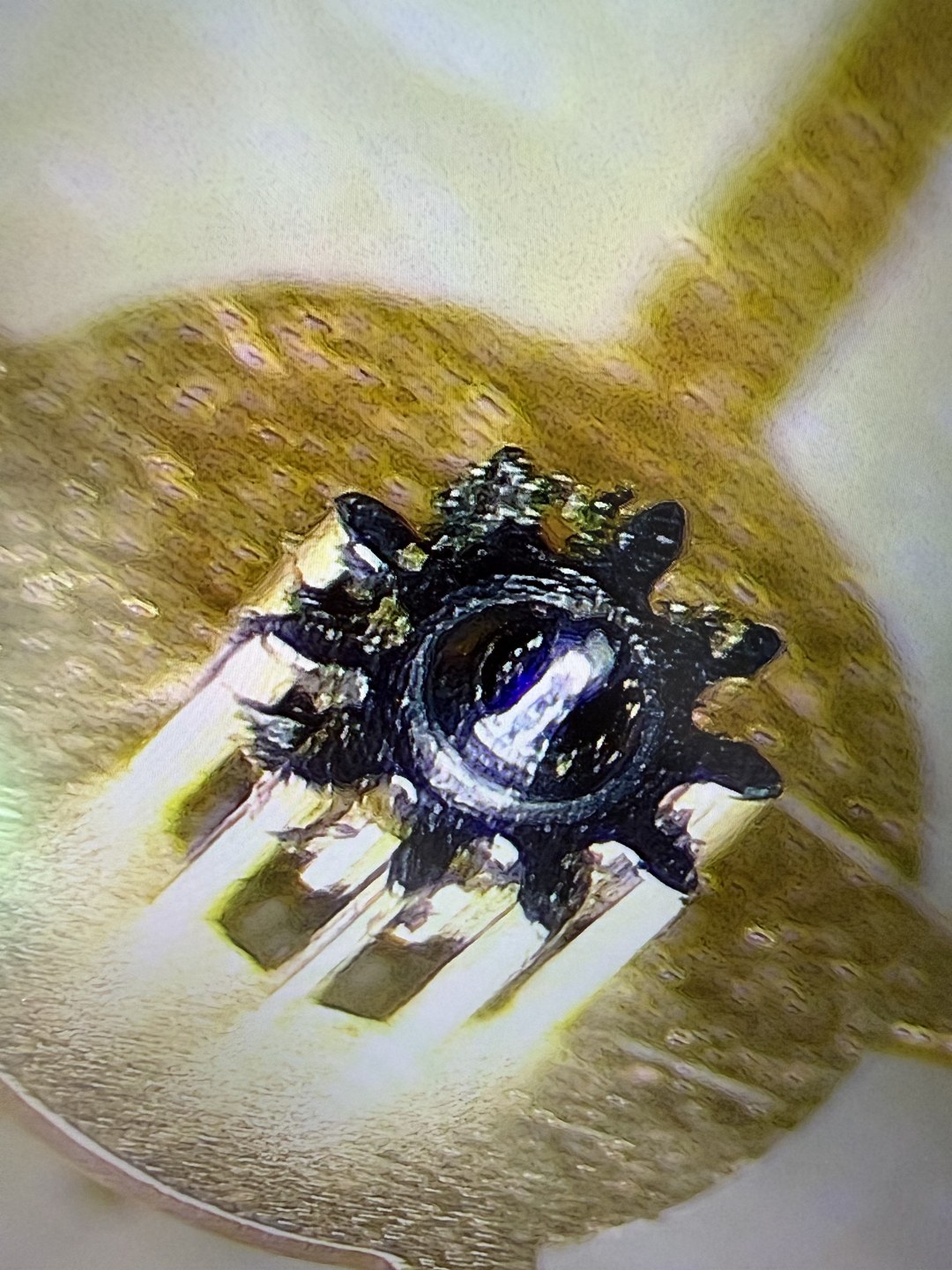
My own work under magnification: small components deserve close attention.
Finally
These checks provide a careful assessment of the watch’s technical condition after a maintenance service. For vintage watches or watches with wear, I assess not only factory values but, above all, realistic and reliable operation within the movement’s capabilities.
A green tick means the check was satisfactory at that time. A red cross means an issue was found that requires further diagnosis, repair or careful use.