
A Visit to the IWC Museum: A Walk Through Innovation, Irony, and Incredible Watches
Let’s be honest—some people love to throw shade at IWC. “Generic movements!” they cry. “Overpriced for what you get!” While that was true in the past, it’s not true anymore. Admittedly, not as nice in finishing as Vacheron Constantin, but much more realistic to own.
Give me a chance to open your heart to this contrarian brand. If you walk through the doors of the IWC Museum in Schaffhausen, you start to realize: this brand isn’t surviving by accident. It’s not just marketing polish. It’s invention, grit, and an attitude to dare to be different.
My kids were excited to visit—my son a bit camera-shy, can you see him in the picture?.

An American in Schaffhausen: The Start of Industrial Swiss Watchmaking
In 1868, Florentine Ariosto Jones, an American engineer, had a radical idea: bring the American system of interchangeable parts and industrial efficiency to the Swiss watch world. Find affordable yet skilled labour, and bring the beauty of Swiss watches to the US.
American watches were of good quality, affordable, production could scale to the masses, and servicing them was considered from the start. Parts were available and interchangeable. Not as pretty as their swiss counterparts maybe—but have you ever seen a nicely finished Waltham, Elgin, or Hamilton? The Swiss watch industry was then dominated by cottage workshops and hand-fitting artisans.
His company, International Watch Company, built its factory in Schaffhausen, harnessing the power of the Rhine, the skill of its people, and impacting Swiss horology forever. Jones helped transplant the “American system” to Switzerland and built one of the country’s earliest fully industrialized watch factories—but he wasn’t the first Swiss maker to adopt factory/industrial methods. Longines opened its integrated “Les Longines” factory in 1867, a year earlier, with mechanised, serial production. The difference from traditional Swiss établissage was huge: centralized production, machine tools, gauges, and interchangeability instead of dispersed cottage parts later hand-fitted by établisseurs.
A Timeline of IWC’s Innovations and Rarities
I wanted to visit the IWC Museum because my very first watch—and the reason I’m now in this world of watchmaking—is an IWC. I own two now: a nice stainless steel Spitfire chronograph from around 2022 and a Cal. 52 pocket watch from around 1896.
I set upon the museum to look up key pieces that are different, daring, and technological marvels. I’m not here to dive into the countless details the pieces have—Google, and you’ll find a plentiful variety of sites and videos from people much more into the weeds then me. With this blog I merely want to highlight and hopefully inspire a few to warm up to this brand.
I’ve done my best to find correct information and factcheck, I apologise to those that find mistakes and get upset over them.
Each of these watches reflects a chapter in IWC’s evolution: some bold, some bizarre, some arguably useless—but all memorable.
1885 – Pallweber Pocket Watch
The world’s first mass-produced digital display watch—with jumping hour and minute discs in place of hands. IWC wasn’t the first to think of a jump-hour (Vacheron Constantin had a jumping-hour pocket watch as early as 1824), and Austrian engineer Josef Pallweber patented his disc-display in 1883. But IWC was the brand that licensed it and scaled it from 1885–1887, producing thousands and making the look famous. It caused quite a stir—novel, futuristic, and unlike anything else—yet proved short-lived due to cost and energy demands; production ceased after a couple of years, which is why these are so collectible now.
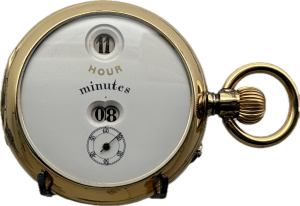
A 19th-century “digital” display — brilliant idea, two-year lifespan.
1935 – Calibre 87 Rectangular Movement
Not a world-first, but IWC’s first tonneau/rectangular wristwatch movement—an Art Deco pivot away from its pocket-watch roots. It’s a stylistic milestone for the brand rather than an industry-wide breakthrough.
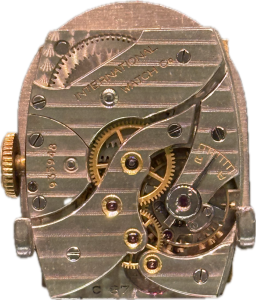
Because round is boring — IWC’s Art Deco experiment in shape-shifting mechanics.
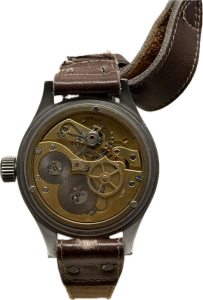
1940 – Calibre 52 T.S.C. & the Big Pilot’s Watch
Based on the big, robust Cal. 52 T.S.C., this powered IWC’s oversized WWII “B-Uhr” pilot’s watches. Size note: the classic IWC B-Uhr (Ref. 431) was a giant 55 mm, with that massive crown for gloved use. The triangle at 12—defined pilot watches for decades.
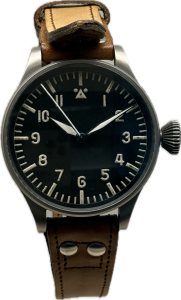
The granddaddy of pilot’s watches — big, bold, and built for the cockpit.
1969/70 – Da Vinci Ref. 3501 (Quartz, Beta 21)
IWC’s first quartz watch, using the Swiss consortium Beta 21 movement developed at the CEH. Announced in 1969 and shown at Basel in 1970, it kept IWC in the conversation during the quartz shock even if Rolex and Omega hogged headlines.
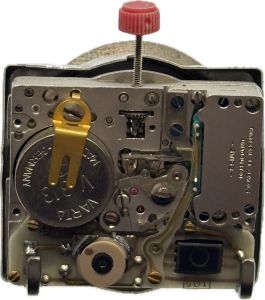
Quartz crisis survivor — sharp suit, electronic heartbeat.
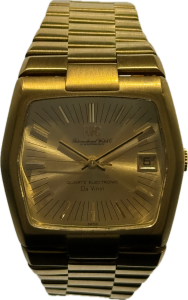
1973 – Calibre 160 Tuning Fork
In the thick of the quartz crisis, IWC experimented with Bulova-style tuning-fork tech, sourcing ESA 9162/9164 movements (IWC cals. 150/160) made under Bulova license. They hum at 300 Hz with that smooth, continuous seconds sweep—an ingenious, short-chapter detour in IWC’s electronic era.
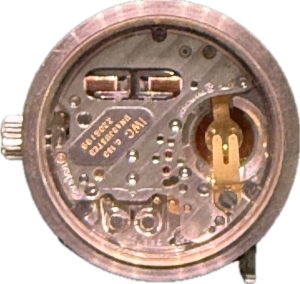
Hums at 300 Hz — smooth seconds, short reign.
1976 – Ingenieur SL “Jumbo” (Ref. 1832)
Designed by Gérald Genta—the same mind behind 2 of the holy trinity watches: Royal Oak and Nautilus—the Ingenieur SL took IWC into the integrated-bracelet, luxury-steel arena. At the time, it flopped; IWC now calls it “our most brilliant failure.” Today it’s cult.
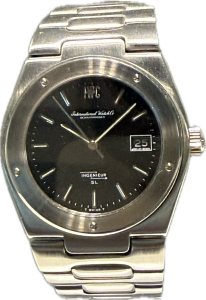
Gérald Genta’s stainless steel statement piece — a “brilliant failure” turned cult classic.
1978 – Ref. 3510 Compass Watch
In collaboration with Porsche Design, this was the first production wristwatch with a built-in magnetic compass, hidden under a flip-up dial module—launched in late 1978 in black or “NATO olive.” It later evolved into the 3551 with additional displays.
The idea of a compass in a wristwatch is older: patents for compass wristwatches appear in 1956 and 1958, and small-run Octo ‘Compass’ pieces show up in the mid-1960s—so IWC’s real ‘first’ is bringing the concept to proper series production.
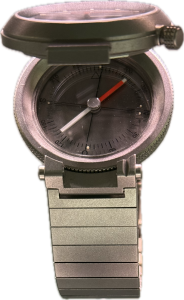
Tells the time, shows the moon, finds your way home.
A nice addition to the compass line is this Qiblah compass, helping people find the direction of Mekka.
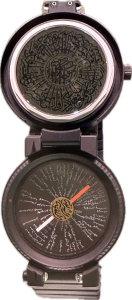
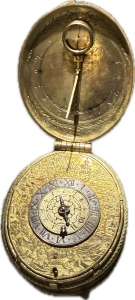
Having a compass is cool, but having a sun dial on your watch is much cooler and essentially the same as a compass if you know how to use it. I found this beauty in the MIH.
1980 – Ref. 3700 Titan Chronograph
Not the first titanium watch ever (that honor goes to the Citizen X-8 Titanium Chronometer in 1970), but IWC’s Porsche Design Titan was the first titanium chronograph and an early series-production titanium watch/bracelet combo—decades ahead of mainstream adoption.
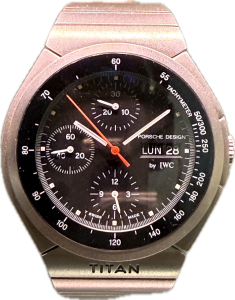
World’s first titanium wristwatch — light as a feather, tough as a dive tank.
1982 – Ocean 2000
A pared-back, FA Porsche–designed dive watch in titanium, rated to 2000 m (200 bar). Why? If you go into divers, why not test the barriers of what’s possible? If it’s worth doing, it’s worth overdoing. One of the earliest serial titanium divers and a statement of engineering minimalism that still looks modern.
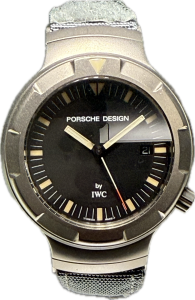
A titanium torpedo rated to 2000 meters — because why not?
I was impressed with the 2.000M only to see the Rolex Deep Sea Special in the MIH a week later, this watch went to 10.000M! It was never produced for the general public.
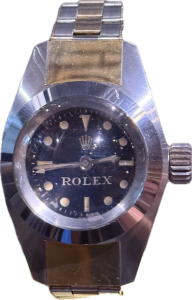
The Rolex Deep Sea Special — the prototype that reached 10,916 meters on the Trieste bathyscaphe in 1960, a watch never intended for the public.
1993 – Il Destriero Scafusia
Built for IWC’s 125th, this grand complication stacked a minute repeater, rattrapante chronograph, perpetual calendar with 4-digit year, and a flying tourbillon. Inside baseball: it’s based on the architecture of the Valjoux 7750 (hand-wound cal. 18680), heavily re-worked. Purists debated the humble base; critics generally applauded the audacity and finishing—either way, it’s a landmark of the ’90s mechanical renaissance.
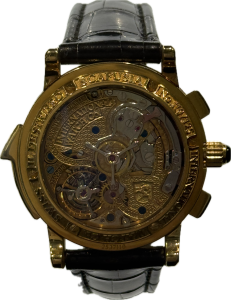
A 7750 at heart, dressed up for the horological Oscars.
1999 – GST Deep One
IWC’s first mechanical dive watch with a built-in mechanical depth gauge using a Bourdon tube: water pressure flexes a coiled tube; that microscopic deformation is translated via linkages to an indicator on the dial. Important nuance: IWC wasn’t first ever—Favre-Leuba’s Bathy 160 (1968) had a mechanical depth gauge—but the Deep One brought a modern, highly engineered take into serial production at century’s end.
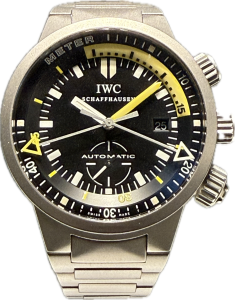
First mechanical depth gauge wristwatch — a diver’s dream with an engineer’s brain
The IWC Grand Complication (1990s)
IWC’s Ref. 3770 combined a chronograph, minute repeater, and Kurt Klaus’s crown-adjustable perpetual calendar (with four-digit year and moonphase). It didn’t try to one-up Patek’s most baroque pieces, but it delivered serious haute horlogerie in a wearably robust package—and helped recast IWC as more than “tool watches only.”
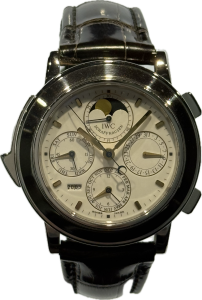
Perpetual calendar, minute repeater, chronograph — all adjusted from a single crown.
Pellaton Was Here… Maybe?
You’d think they’d shout about it. Albert Pellaton’s winding system—developed in 1950—is still the backbone of IWC’s automatics. Seiko’s Magic Lever? It’s Pellaton’s concept, simplified. Yet at the museum… I either missed it or it wasn’t emphasized. Maybe I was distracted trying to keep my son and his coloring from turning into modern art on a boutique display.
Either way, it’s worth celebrating and certainly deserves a separate mention in a story to open people’s hearts to the craftsmanship and innovation of IWC. Pellaton’s dual-pawl winding mechanism replaced more complex reversing gears with a smoother, more efficient system that’s still used today—now with ceramic components.
The below model is the one we have at Zadkine. I unfortunately was not able to find it in the museum
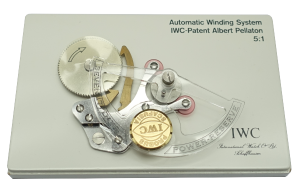
The winding workhorse still powering IWC automatics 70+ years later.
Visiting the IWC Museum — It’s More Than Watches
- Historic setting: The museum sits inside IWC’s original 19th-century factory—flooded with light, charm, and a view of the Rhine. Exhibits are paired with interactive screens and a multimedia brand history.
- Parking? Easy.
- Park across the street: Perfect for partners who’d rather stroll than scroll through 150 years of gear trains.
- Touchscreen tablets: Yes—interactive stations and multimedia displays throughout. They even have tablets for kids per age group to keep the little ones busy so you can focus on the cool stuff
- Boutique next door: I got to try the latest Pilot’s Chronograph Performance. Friendly staff, no pressure, just good vibes.
- Coloring books for the kids: Yes, with nice pencils. Yes, they were entertained. Yes, I actually got to read museum plaques in peace.
Reflections on the Criticism: Generic Movements, Expensive Watches
It’s true—some IWC watches used ETA or Valjoux bases, even in high-end models. That bothers some collectors. But IWC turned a humble 7750 into one of the most complicated watches of its day (see Il Destriero), produced rugged titanium long before it was cool, and made a perpetual calendar you could adjust from the crown—mechanically programmed to 2499. Crucially, the brand’s early, factory-driven approach and later engineering-led storytelling (Genta’s Ingenieur SL; Porsche Design collabs; the ’90s complications) helped carry Swiss mechanical watchmaking through the dark days of quartz—by reframing mechanics as engineering luxury rather than commodity timekeeping.
It’s also worth stating clearly: IWC builds a lot of in-house calibres now. The 7-day 52000 family (ceramic Pellaton), the 82000 family (Pellaton architecture), and the 69000 in-house chronographs appear widely across the lineup; entry 32000/32111 also shows up in modern Ingenieurs at 120-hour reserve. The old “generic ETA inside” jab doesn’t map to the current core collections.
Mass production didn’t dilute their watchmaking—it preserved it and, along with many others, helped the entire industry survive troubling times.
Final Tick
Whether you love haute horology or just love a good story in steel and gears, the IWC Museum is worth the visit. It’s a look at how one brand embraced change, challenged tradition, and helped keep the mechanical watch out of extinction—and did it all from a quiet little town on the Rhine.
Bring your curiosity. Bring your kids. And bring an extra sleeve—just in case you leave with something ticking on your wrist.